When you buy through links on our articles, Future and its syndication partners may earn a commission.

For the first time in more than 50 years, humans are cruising through lunar space.
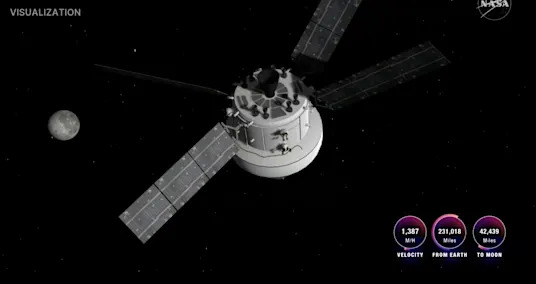
The four astronauts of NASA's Artemis 2 mission arrived in the moon's sphere of influence — the region where lunar gravity exerts a more powerful pull than that of Earth — today (April 6) at 12:37 a.m. EDT (0437 GMT).
The milestone occurred when the mission's Orion capsule was about 39,000 miles (62,764 kilometers) from the moon and roughly 232,000 miles (373,368 km) from Earth, a commentator said during NASA's Artemis 2 livestream.
The Artemis 2 astronauts — NASA's Reid Wiseman, Victor Glover and Christina Koch and the Canadian Space Agency's Jeremy Hansen — are the first people to cross the lunar threshold since December 1972, when the three-person Apollo 17 moon-landing mission did so.
Artemis 2 will not touch down on the moon, or even enter lunar orbit. Rather, Orion will loop around the moon's far side this evening in a history-making flyby. During that encounter, Artemis 2 will get farther from Earth than any crewed flight ever has.
The distance record is currently held by the Apollo 13 astronauts, who got 248,655 miles (400,171 km) from our planet in April 1970. At the height of tonight's flyby, just after 7 p.m. EDT (2300 GMT), Artemis 2 will be 252,757 miles (406,773 km) away from the rest of humanity, NASA officials have said.
The Artemis 2 astronauts will study the moon during the flyby, gathering data that could help scientists better understand the terrain and geology of Earth's nearest neighbor. They'll also be treated to a total solar eclipse, which will not be visible to those of us here on terra firma.
In addition, the flyby will chart their path home: Lunar gravity will slingshot Orion back toward Earth. Artemis 2 astronauts will come home on Friday (April 10), ending their 10-day mission with a parachute-aided splashdown off the coast of San Diego.
Editor's note: This story was updated at 1:15 a.m. EDT on April 6 with NASA's revised time of Orion's entry into the moon's sphere of influence — 12:37 a.m. EDT rather than 12:41 a.m. EDT.
LATEST POSTS
- 1
 21 Things You Ought to Never Tell Your Childless Companion
 - 26 Solid Moving Administrations for a Calm Movement
- 3Reality TV star Spencer Pratt, who lost his home in Palisades Fire, is running for mayor of Los Angeles
- 4Rights groups condemn Israel Police decision to ban Sudan Genocide protests nationwide
- 54 injured in shooting at North Carolina tree lighting ceremony


- Beyond the habitable zone: Exoplanet atmospheres are the next clue to finding life on planets orbiting distant stars
- 7 Powerful Techniques to Boost Efficiency with Your Cell Phone: A Thorough Aide
- Israel strikes Iranian nuclear development facilities, Tehran vows retaliation
- Greece eyes migrant repatriation centres outside the EU
- Why boosting production of Venezuela's 'very dense, very sloppy' oil could harm the environment
- Telecommute Arrangement: What's Pivotal for Your Efficiency?
- Hezbollah sees potential win as Israel backs down from disarmament goal
- Merz: 80% of Syrians in Germany expected to return within three years
- Novo Nordisk cuts Wegovy price in South Africa for a second time